
Traveling with a Cat in the United States
Whether you’re planning a state-to-state road trip or flying to a new city, understanding the veterinary paperwork and requirements is crucial for a stress-free journey. As a fellow cat lover, I know how overwhelming all the red tape can seem. In this guide, I will walk you through every detail you need to know about traveling with your kiddo—especially when it comes to paperwork, costs, and key timelines. Let’s dive in!

What is a Health Certificate?
Requirements to cross state borders with a cat is, typically, a Certificate of Veterinary Inspection (CVI a.k.a. Health Certificate). This allows government officials know your kiddo is up to date on required vaccines and you own this pet since each state does require you to have a pet license. A pet health certificate lasts 30 days from the issue date. Each state and region is going to be different on their laws and requirements, so be sure to do your research.
Many pet owners choose not to get a health certificate if they are just driving across state borders. It is still required to have a health certificate even if you are just driving across state borders since this paperwork provides proof that you own your kiddo and they are up to date on shots. If you do not have this paperwork available, if you get pulled over during travel, law enforcement can legally take your kiddo and it is a long and expensive process to get them back.
I highly recommend having this paperwork and plan ahead if you plan to travel over the 30 day period of expiration of the health certificate. You will need to go to a local veterinary practice to get a new one. Please note that some practices can take 24-48 hours to get the paperwork done and be sure that it can take up to a week to get a regular appointment scheduled. If, you need same day appointment or within the week, be prepared it may need to be urgent care cost rather than primary care appointment cost.
For air flights, some companies require the health certificate while some only require rabies vaccine certificate and microchip. Do your research and still note that crossing state borders will require a health certificate.
Understanding the Paperwork
To receive this paperwork, it will need to be a 40–60-minute appointment at the vet depending on if you are a new client or your pet will be a new patient. It also depends on the equipment the practice has. Most practices are up to date on their equipment and knowledge.
What You Need for the Appointment
Addresses: You will need to provide your current address and your official destination address. This includes the address of any homes you will be staying at, hotels, resorts, etc.
Rabies Certificate: You will receive a rabies certificate signed by a licensed Veterinarian each time your kiddo receives the vaccine. This shows that there is legal proof that your kiddo was vaccinated by a veterinarian with a good, non-expired vaccine and your kiddo was healthy enough for the vaccine to be effective. This is why it is required to have a primary appointment for a rabies vaccine for all pets. Note: The rabies vaccine needs to be given no later than 30 days prior to the receival date of the health certificate. This is to ensure the vaccine is in the kiddo’s system and working. Plan ahead, folks. Please check my vaccine series on why Rabies is required by law, if you are curious.
State License Paperwork for Your Pet: Some practices will create the license for you, sometimes you have to go to specific shelters to receive the state license. I recommend having this done with the rabies vaccine if a veterinary practice can do it for you. This paperwork is proof you own your pet in your current region and state. Be sure to call ahead of your appointment to see if the staff can do this for you.
Vaccine History and Receipts: The best way to show proof your pet is up to date on all vaccines is the receipts practices give to you when you pay for your appointment. The receipts tend to show what vaccine was given and when.
Health History Notes: You only need this paperwork if your kiddo has health issues you are concerned about or your kiddo takes regular medication. This is so the veterinarian can evaluate your kiddo during the appointment and make sure it is safe for them to travel.
One way to keep everything organized is a folder or binder. I have one binder for both of my cats and I use divider tabs to keep everything organized between them two. It is divided between each of their names, veterinary receipts (vaccines, urgent care, all procedures and all emergency visits), rabies certificates and adoption paperwork. To keep everything neat (you pick your own method) I put the paperwork in cover sleeves. The sleeves help prevent too much damage and natural wear and tear.
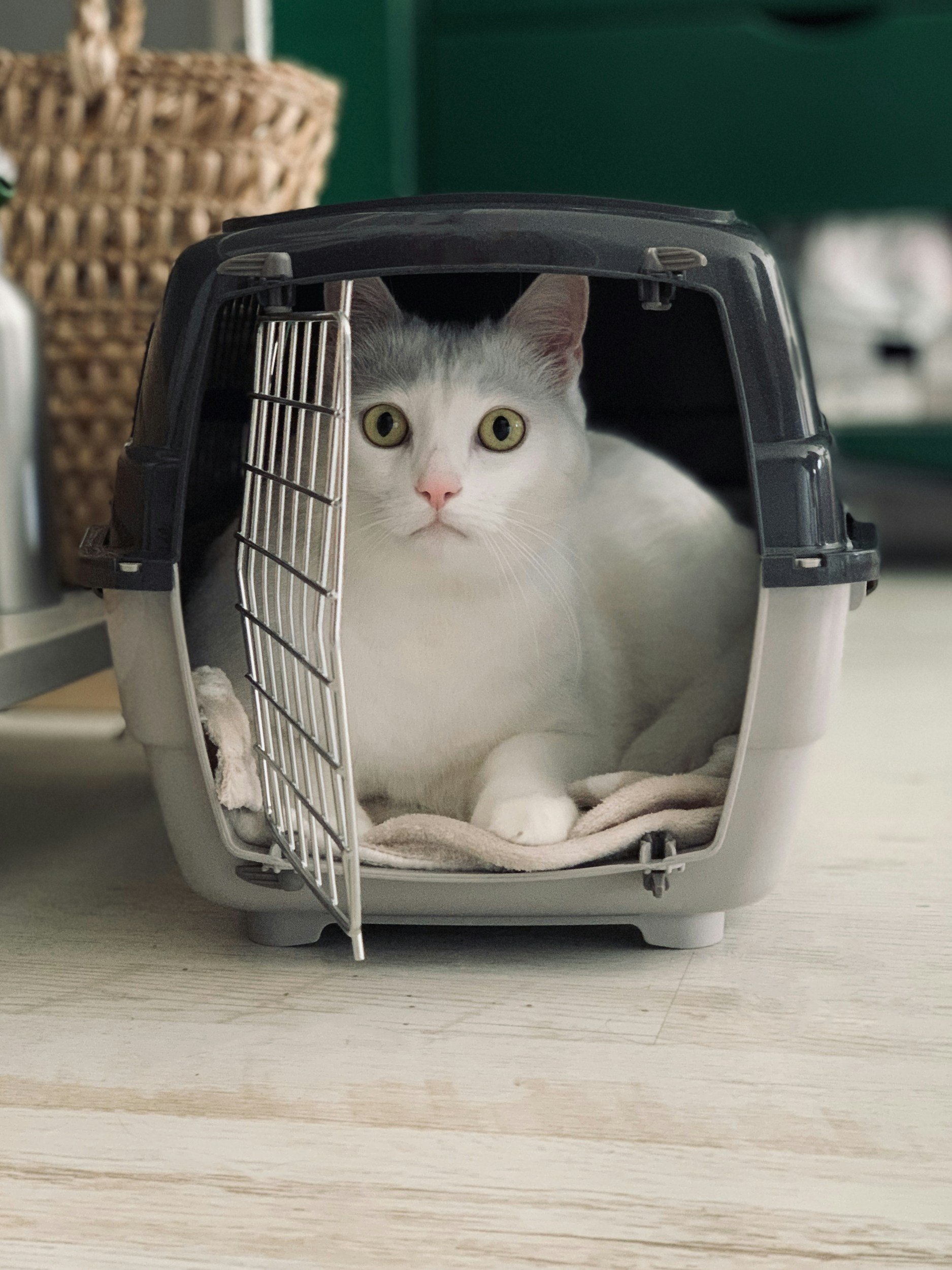
Traveling By Air with Your Cat (Domestic U.S. Flights)
Requirements for your pet will vary on the company you are flying with. DO YOUR RESEARCH AHEAD OF TIME. Some airlines are stricter than others.
Health Certificate: Some airlines will require a health certificate; some will not. It is important to have the health certificate because, even though your kiddo may be safe for the flight, does not mean the state you land in will not take your kiddo away. Have the health certificate ready.
Rabies Certificate: The rabies certificate will be required no matter where you go.
In-Cabin vs. Cargo: This is another reason why you need to do your research ahead of time. In-cabin means your kiddo will be seated with you either in their own paid seat or under the seat like a purse or backpack. Cargo flight tends to be for larger breeds and smaller airlines. There will be extra fees for flying with your pet whether they have their own seat or not.
Medication: Check airline policies if your kiddo takes medication regularly or just for travel. Some airlines do not allow pets on board if they are given certain medication (like gabapentin for cats) because certain medication can make the kiddo drowsy, therefore their breathes per minute are less, which means the kiddo is getting less oxygen. It is a risk certain airline companies do not want to take since there is slightly less oxygen flying.

Required Vaccines
Rabies (RV)
Rabies is a viral infection that is spread through infected animal saliva. Most mammals that have gotten infected have been bitten by an infected animal. The virus is 100% fatal to all mammal (even humans), but preventable. Once symptoms start, the mammal usually passes within 3-4 days. This disease is zoonotic, which means it is transferable from animals to humans.
This disease is so serious that each country and each state have to report what mammal and how many mammals have been reported positive for the disease. The disease cannot be diagnosed, however, until the mammal dies.
Symptoms
Early signs can be very subtle, but once symptoms start things can escalate very quickly. Early signs of rabies virus are normally mild fever, loss of interest in food, and slight fatigue.
Severe symptoms tend to appear within 2 weeks of the early signs. More severe symptoms include:
Seizures and neurological symptoms and changes
Behavior changes (tend to be aggressive and want to bite)
Drooling
Paralysis
Dysphagia (difficulty swallowing)
Treatment
Unfortunately, there is no known treatment for Rabies. Pets tend to deteriorate in health within a few days of initial signs and symptoms. Typically, depending on the state and country, pet has to be euthanized if showing signs and symptoms of rabies virus.
Legal Requirements for Rabies Vaccination in the U.S.
By law, every pet is required to be up to date on Rabies vaccine starting at 4 months (16-18 weeks old). This is the only pet vaccine that is required by law.
Be sure to check laws varied by state and even by county because state and county laws can be more or less strict.
Rabies booster schedule is based on state and county laws. Some locations allow for a booster every 3 years, others require a booster every year.
Penalties for Non-Compliance with Rabies Laws
Be sure to do your research based on the state (or country) you live in and your local county. I will attach direct link(s) below.
Penalties for not complying with Rabies schedule laws vary by state and county.
General penalties according to federal law are:
Fines: Can range between $25- over $1000 depending on location. Some locations and circumstances will offer suspension or decrease in fine amount if owner agrees to get vaccination done by a specific date. For example, Denver has a $100 fine for a first offense, then a $250 fine for the second offense.
Quarantine: If an unvaccinated (never been vaccinated with rabies or for a long period of time) or overdue vaccinated pet is exposed to a rabid animal, authorities may require your pet to be under a strict quarantine at the owner’s expense.
Euthanized: Worst case scenario, an unvaccinated pet is exposed to a rabid animal, the pet is at risk to be euthanized. This is because rabies cannot be tested unless patient has passed and you don’t know if the patient has rabies at all when they are alive unless they are showing clear symptoms, unfortunately.
Jailtime or imprisonment: This not common, but not off the list. This can be due to repeat offenders or depends how severe the rabies was and how it was caused.
Feline Viral Rhinotracheitis, Calicivirus, Panleukopenia (FVRCP)
Feline Viral Rhinotracheitis: “FVR”: This is a highly contagious (between cats) respiratory, viral infection caused by the Feline Herpesvirus type-1 (FHV-1). This is transmitted through direct contact with nasal, saliva and/or eye secretions of an infected cat. This can be a 1- or 3-year vaccine itself.
Calicivirus: “C": A highly contagious viral upper respiratory infection (URI), also known as, “cat flu”.
Panleukopenia: “P”: A highly contagious viral infection caused by the feline parvovirus (not like dog parvovirus, therefore, not contagious to dogs). This is also known as, feline distemper. It mainly affects a cat’s immune system causing vomiting, diarrhea, lethargy, fever, and dehydration. This disease tends to be most common in kittens (just like canine parvovirus for puppies).
Chlamydophila felis (FVRCP-C or FVRCP-Ch): This is a bacterial infection and inflammation of the eye (conjunctivitis “pink eye”). This is where the eye gains discharge, is very swollen and red. It can cause sneezing and nasal discharge especially in kittens. It is highly contagious between cats.
This vaccine is not always required, but many airlines and states require it for travel.

Step-by-Step Process for Obtaining Travel Paperwork
Step One: Do research on the airline you plan to travel on and regional laws for vaccine and paperwork for pets traveling. Figure out your end destination address and how long you plan to travel with your kiddo.
Step Two: Book your flight, if you plan to fly with your kiddo.
Step Three: Get your kiddo’s records organized. Be sure to have all most recent vaccine receipts and rabies certificate. If you are not confident your kiddo is not or will not be up to date on vaccines during the trip, schedule a vet visit to get those vaccines done at least a month prior to the health certificate visit date. Many states and countries require your kiddo to be vaccinated with at least rabies 30 days prior to travel.
Step Four: Schedule the vet visits. The health certificate is a 40–60-minute visit depending on if your kiddo is a new patient. If your kiddo needs vaccines, schedule the vaccine appointment 30 days prior to the health certificate vet visit. For the health certificate visit, the veterinarian may request information about your trip prior to the appointment to save time day of the appointment. Be sure to plan ahead some (very few) locations may need 24-48 hours to get the paperwork finalized. Veterinarians have to double and triple check all the information to make sure every single detail is correct to help your travel be as smooth as possible. Be sure to schedule a vet visit at the state you will be staying at if your health certificate is going to expire during your travels.
Step Five: Triple check all the paperwork and make sure you have a travel folder for your kiddo with the health certificate and rabies certificate.
Costs of Veterinary Paperwork, Visits and Vaccines
Costs are going to vary based on state and region.
Vet visit: $40-$60
Rabies vaccine and certificate: $25-$40
FVRCP vaccine: $45-$55
Health certificate: $100-$200 (domestic travel)
Medications: $10-$30
Medication for Travel
If your kiddo is on medication and you are flying, make sure the specific medication is allowed. There are safety precautions airlines are taking if a kiddo seems too unconscious (whoozy). Typically, owners will request gabapentin for a cat to help a cat stay calm during travel. Another option you can consider is calming treats or CBD calming treats. The treats are not as intense as gabapentin and may be effective. Be sure to allow your kiddo to try them ahead of time to be prepared.

By understanding the required veterinary paperwork, vaccine rules, and potential costs, you can plan ahead and avoid last-minute surprises. Do not forget to ask your vet the right questions and start preparations early—sometimes weeks in advance. Whether you are hitting the road or taking to the skies, being informed means more snuggles and less stress for both you and your kiddo. Start by booking that vet appointment and make your kiddo’s journey a safe and happy one. You got this!